
Working Food maintains seed from many watermelon varieties, some newly introduced to our collection and others that had not been evaluated in many years. Growing these varieties side-by-side allows us to learn which ones thrive in our local conditions and which ones provide the best eating experience.
Variety trials are a key part of community seed stewardship—they help us make informed decisions about what seeds to save, adapt, and share with future growers. Through this process, we seek to answer two simple but important questions:
Does the variety grow well here?
Does the variety taste good?
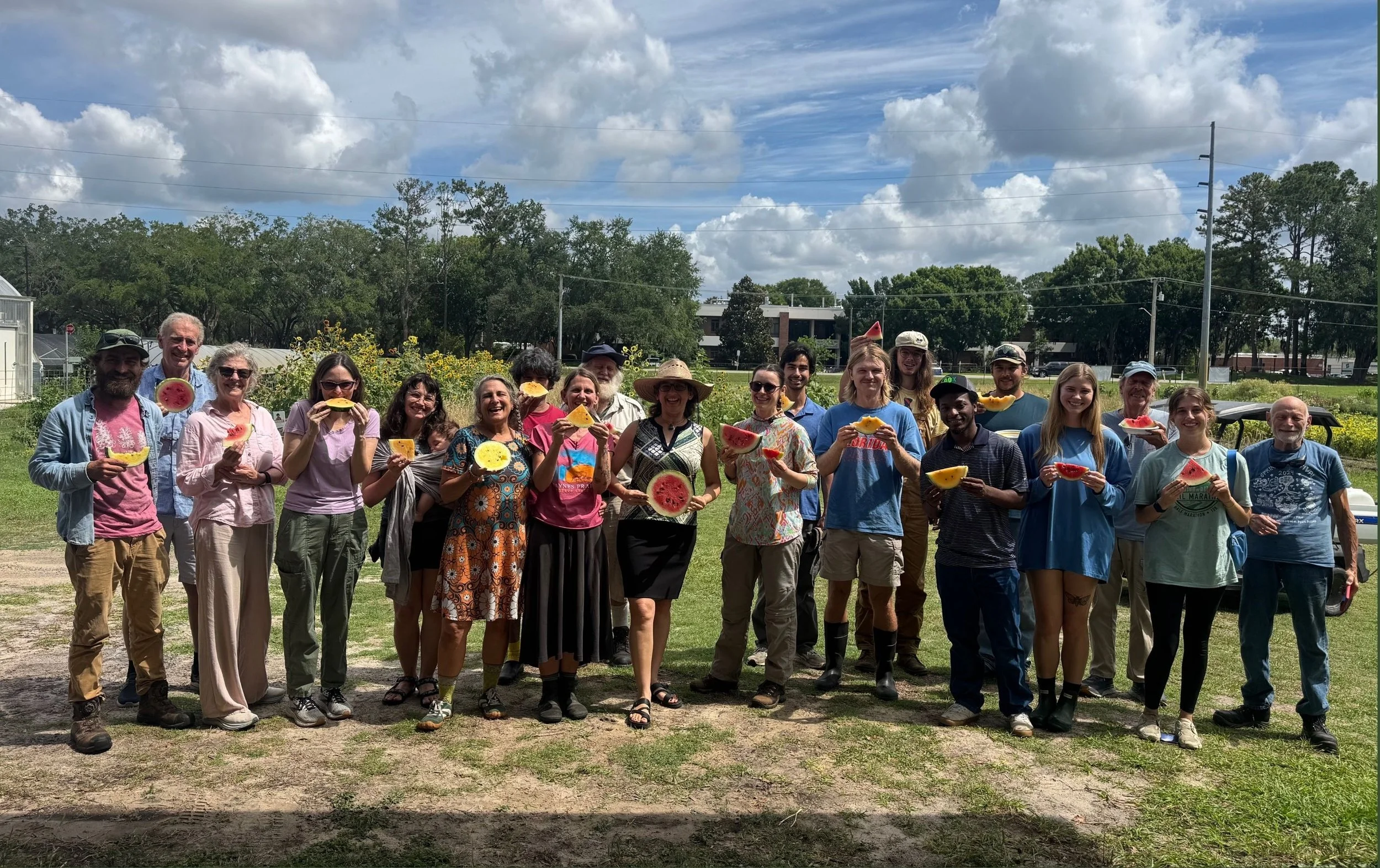
Watermelon variety trial crew
In the spring of 2026, we successfully grew and harvested more than 1,440 pounds of watermelons. This was possible through our partnership with the University of Florida Horticultural Sciences Teaching Farm and their amazing staff. Thank you Zack, Jared, and Youssef. We also received support from our longtime dedicated volunteer Cyd, who assisted with weeding and harvesting throughout the season.
The harvest was shared with many community members!

Youssef helping with the watermelon harvest
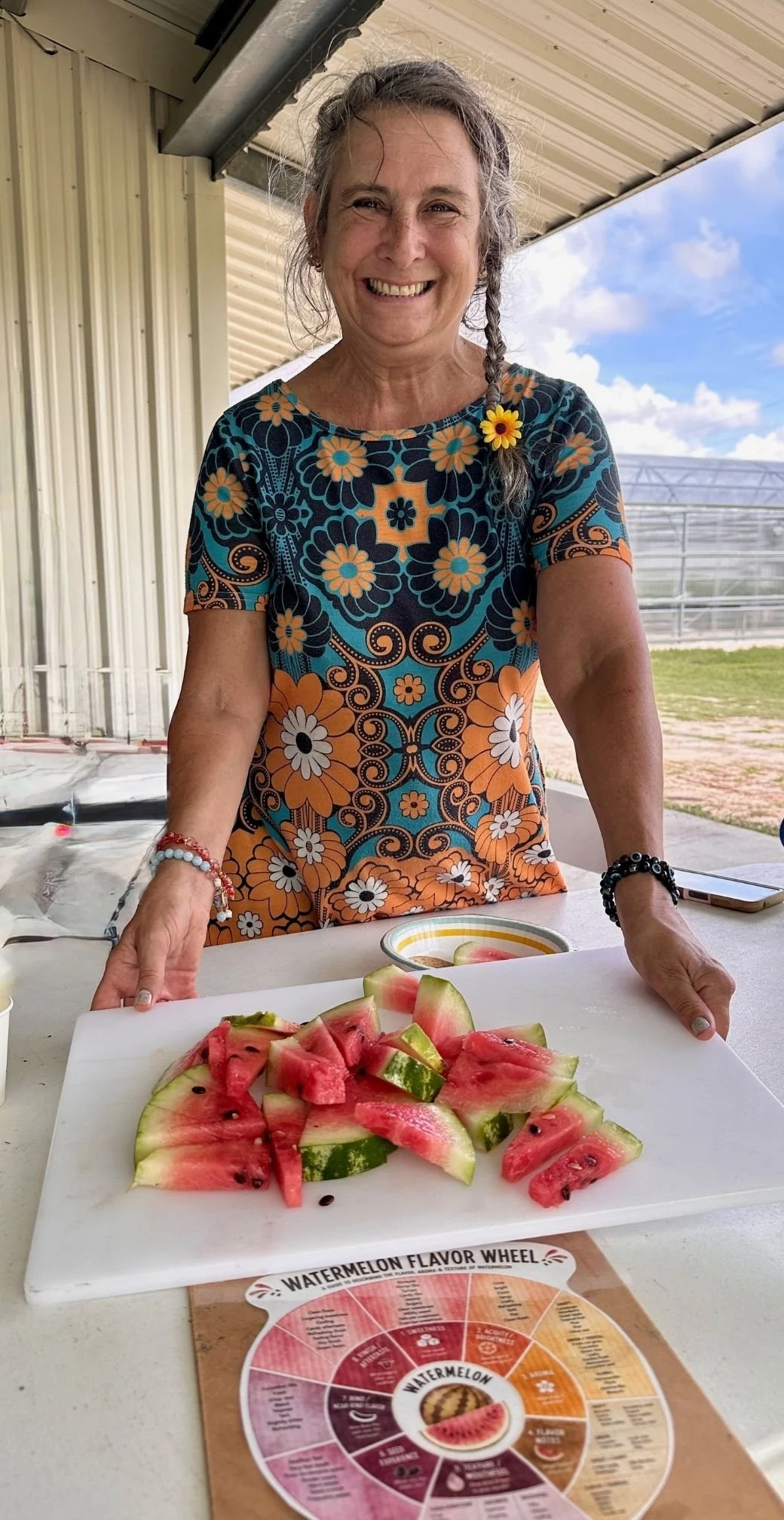
Cyd offers up watermelon slices at the first tasting event
Readers interested in more details about the project, methodology and results can read the full version below.
Trial Details
Seeds were sown in the greenhouse on Feb. 17, 2026.
Seedlings were transplanted into the field on March 11 and March 20.
The trial was completed on June 8, as harvests began to drop and the temperature, pests, weeds and disease became higher. Six varieties of watermelon were chosen to evaluate.
Each variety was replicated in two separate growing blocks within the field to help reduce any unknown field effects that can impact growth.
Each variety was evaluated multiple times throughout the season for disease and pest pressure using a 0–10 scale, with 0 indicating no observed pressure and 10 indicating very high pressure.
Three collaborative tasting sessions were held with 36 participants. Tasters were encouraged to discuss their observations, and a flavor wheel was provided to help describe taste, aroma, and texture.
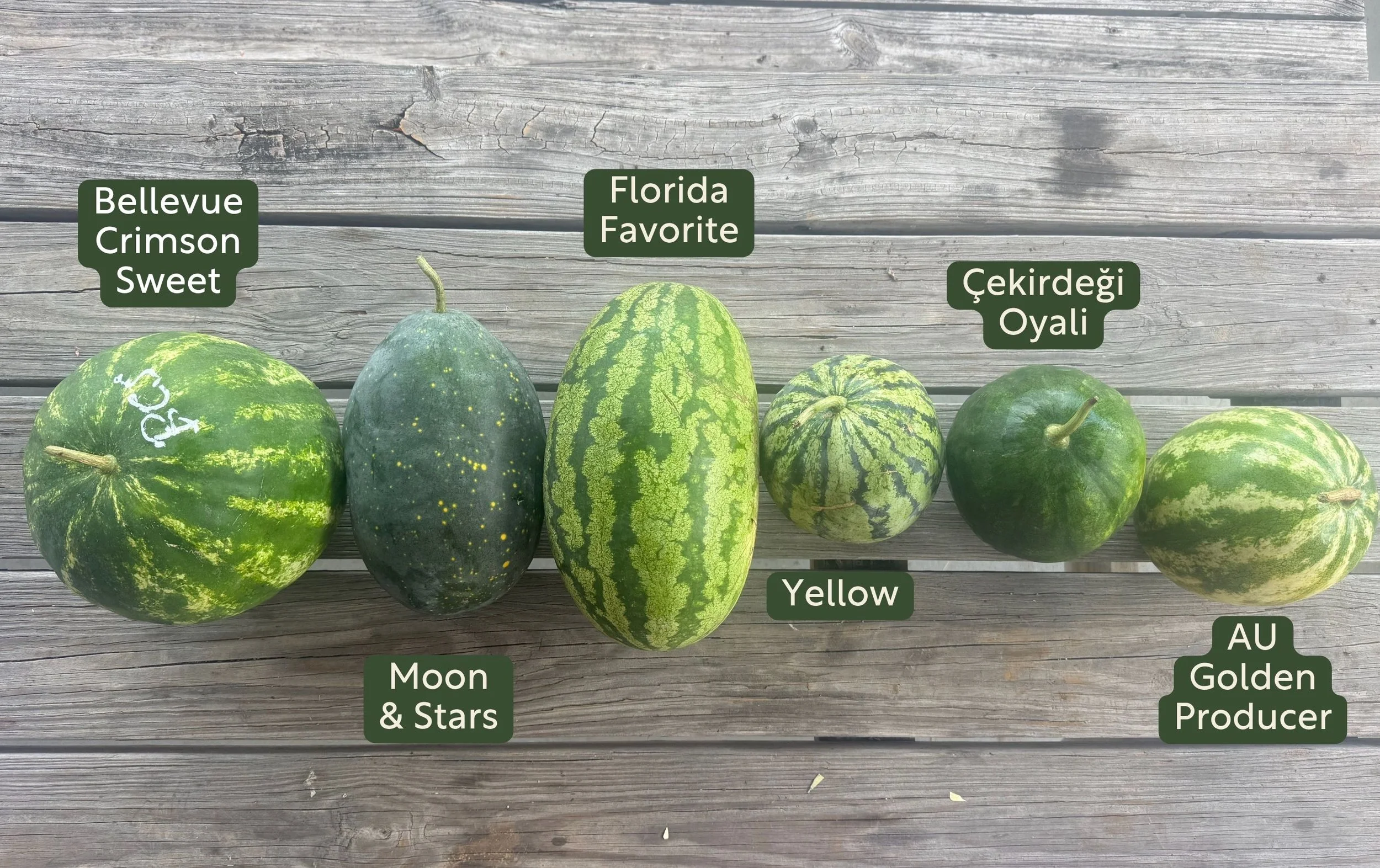
six watermelon varieties on a wood table
Overall Summary
AU Golden Producer
Variety background: Obtained through Heron Breen, who pulled this from the USDA National Plant Germplasm System. Developed at Auburn University in the early 1990s, AU Golden was bred for resistance to several common watermelon diseases. It traces its lineage back to Crimson Sweet and arose from a naturally occurring mutant plant discovered during another watermelon breeding project for AU Producer. Although once patented, the patent has expired, leaving this open-pollinated variety freely available for seed saving and breeding. Seed is not commercially available.
AU Golden Producer was one of the most reliable and well-rounded performers in the trial, exhibiting vigorous vines, excellent ground cover, minimal pest and disease pressure , and no observed fruit rots or splitting. Early maturity and consistent harvest indicators resulted in very few underripe fruits, making it one of the easiest varieties to manage.
Median weight: 9 lb (AU Golden Producer produced the heaviest fruit in the trial)
Productivity: Averaged 1.1 fruit per plant (tied for fourth in productivity)
Brix measurement: 10.1° (highest in the trial)
Disease and pest pressure scale: 2/10
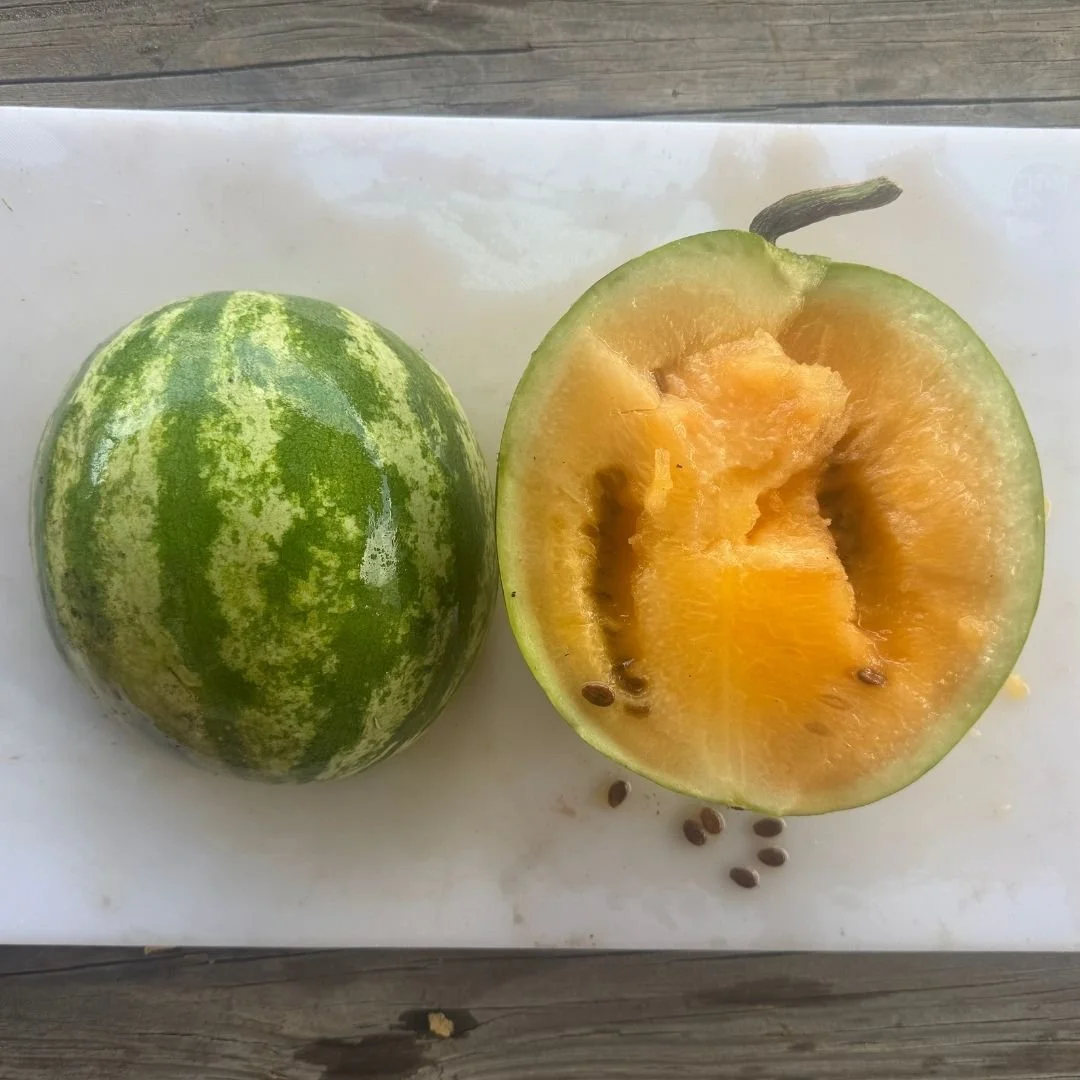
AU Golden Producer watermelon
Taste profile: Tasters consistently praised its attractive creamsicle-colored flesh, crisp yet melting texture, refreshing flavor with honeydew, tropical, and floral notes, and edible, flavorful rind. While sweetness was moderate rather than intense, its consistency, eating quality, manageable size, and strong field performance make it an excellent candidate for continued selection, climate adaptation, and community seed sharing.
Bellevue Crimson Sweet
Variety background: A locally adapted variation of the popular Crimson Sweet watermelon that has been stewarded by Tommy Simmons of Bellevue Gardens in Archer, Florida, since the 1990s. One remarkable feature of this variety is that it has been maintained without irrigation. For decades, seed has been saved only from plants that successfully germinated, grew, and produced fruit using rainfall alone, potentially contributing to greater drought resilience under North Florida conditions. Seed for this local variation is not commercially available, but Crimson Sweet is widely available.
Bellevue Crimson Sweetwas one of the strongest performers in the trial, combining excellent field vigor, high productivity, and good eating quality. Plants developed vigorous vines, dense ground cover, and showed very low disease pressure with minimal pest issues, despite the early loss of six plants. Several fruits became overripe before harvest, resulting in 7 rots and 2 splits, likely reflecting its adaptation to drier, sandier conditions and sensitivity to higher moisture levels from irrigation and rainfall.
Median weight: 8.0 lb
Productivity: 1.7 fruit per plant (second most productive variety)
Brix measurement: 9.0°
Disease and pest pressure scale: 1/10
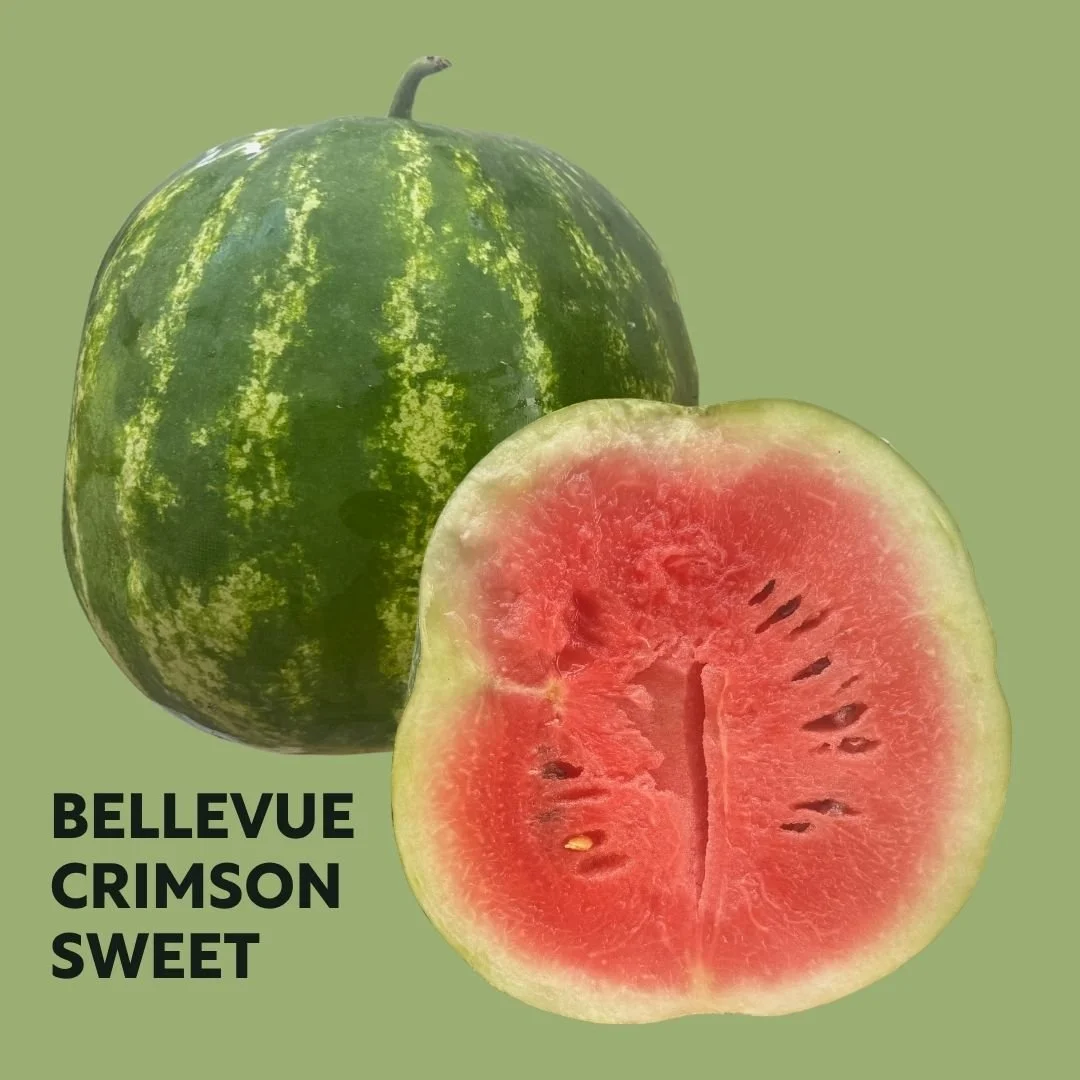
Bellevue Crimson Sweet watermelon
Taste profile: Tasters appreciated its juicy, silky texture, low seed burden, appealing color, and classic watermelon flavor with subtle tropical and apple-like notes. Although sweetness and firmness varied with ripeness, well-matured fruit were highly enjoyable.
This variety shows strong potential for continued locally adapted seed selection, particularly in lower-input or drought-prone systems where irrigation management can be carefully balanced.
Çekirdeği Oyali
Variety background: A Turkish heirloom watermelon known for its striking ornamental seeds. We originally obtained this variety from Mehmet Oztan of Two Seeds in a Pod. Both red- and orange-fleshed forms exist and we have grown both in the past. The seed used in this trial was saved from an orange-fleshed planting that had been grown near red-fleshed plants, so some crossing may have occurred, resulting in additional variation within the population. Seed for both are commercially available through a few select seed companies.
Çekirdeği Oyali produced vigorous vines with excellent ground cover. It produced the smallest fruit of all varieties tested, making it well suited for CSA, market, and household-scale production. The dark rind was visually appealing, though some fruit developed an unusual netted surface pattern, and the dense canopy made fruit difficult to locate. Harvest timing was a major challenge, as maturity indicators were inconsistent and resulted in many underripe harvests.
Median weight: 4.4 lb (smallest fruit of all varieties tested)
Productivity: 1.5 fruit per plant (third most productive variety)
Brix measurement: 7.7°
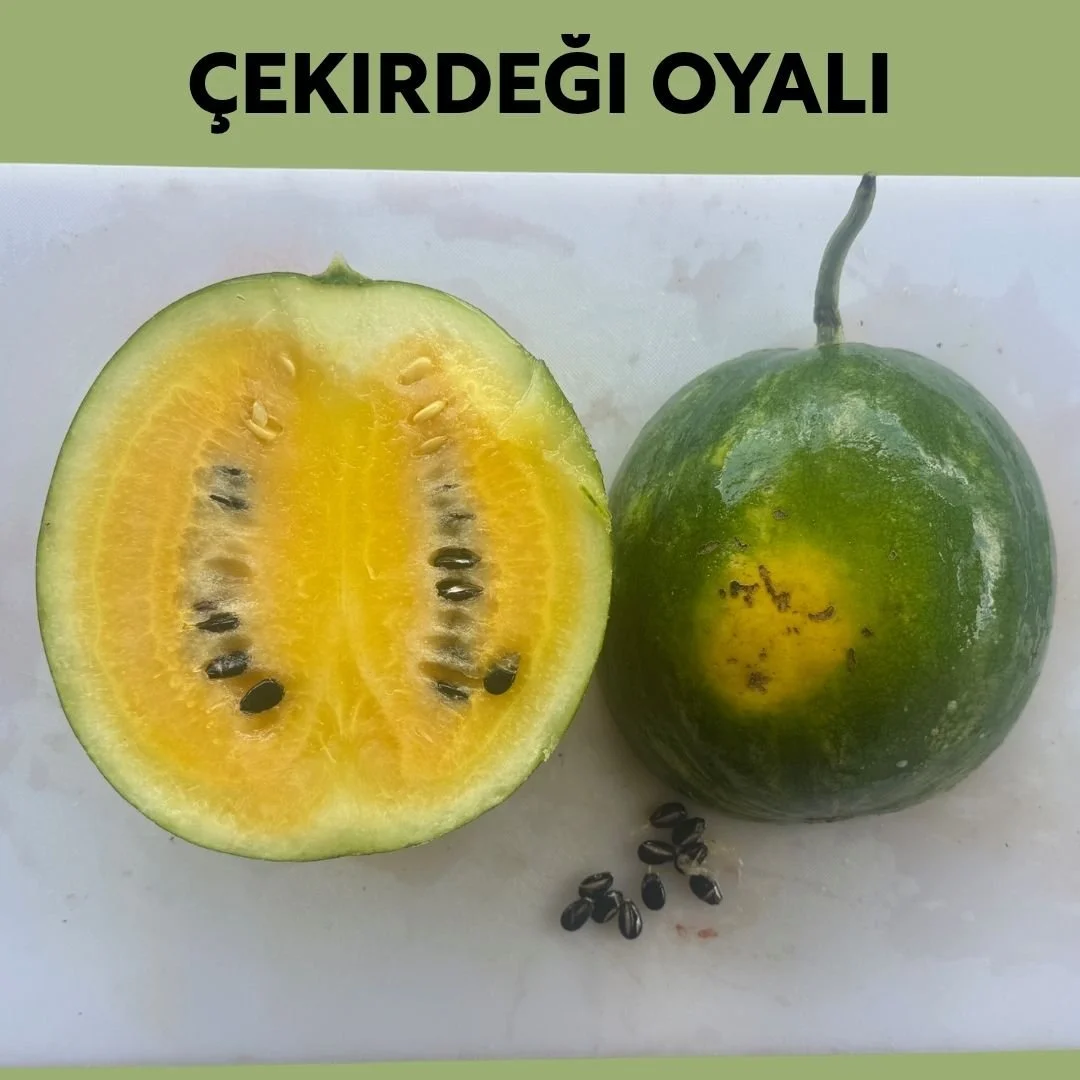
Çekirdeği Oyali watermelon
Taste profile: Tasters consistently noted its high juiciness but found sweetness, flavor intensity, and texture less competitive, with mild vegetal notes, soft flesh, and abundant seeds. While its unique and beautiful seeds, compact size, and productivity are appealing, inconsistent maturity and limited flavor performance place it as a lower priority for future planting. Two more orange-fleshed selections received positive feedback, and seed was saved for possible future evaluation.
Florida Favorite
Variety background: Obtained through Heron Breen, who pulled this from the USDA National Plant Germplasm System. Florida’s Favorite remains somewhat mysterious. Available records provide conflicting accounts of its origins, suggesting it may have been developed by a seed company, university breeding program, or independent farmer. Given its intriguing name and Florida connection, we were eager to evaluate it under local growing conditions. Seed is not commercially available.
Florida Favorite produced vigorous vines with abundant ground cover and was one of the most visually appealing varieties in the trial, with attractive rind patterns, color, and oblong fruit shape. However, field performance was inconsistent, with unreliable maturity indicators resulting in many underripe harvests, along with 6 fruit rots and 1 split.
Median weight: 7.3 lb
Productivity: 1.1 fruit per plant (tied for fourth most productive)
Brix measurement: 8.25°
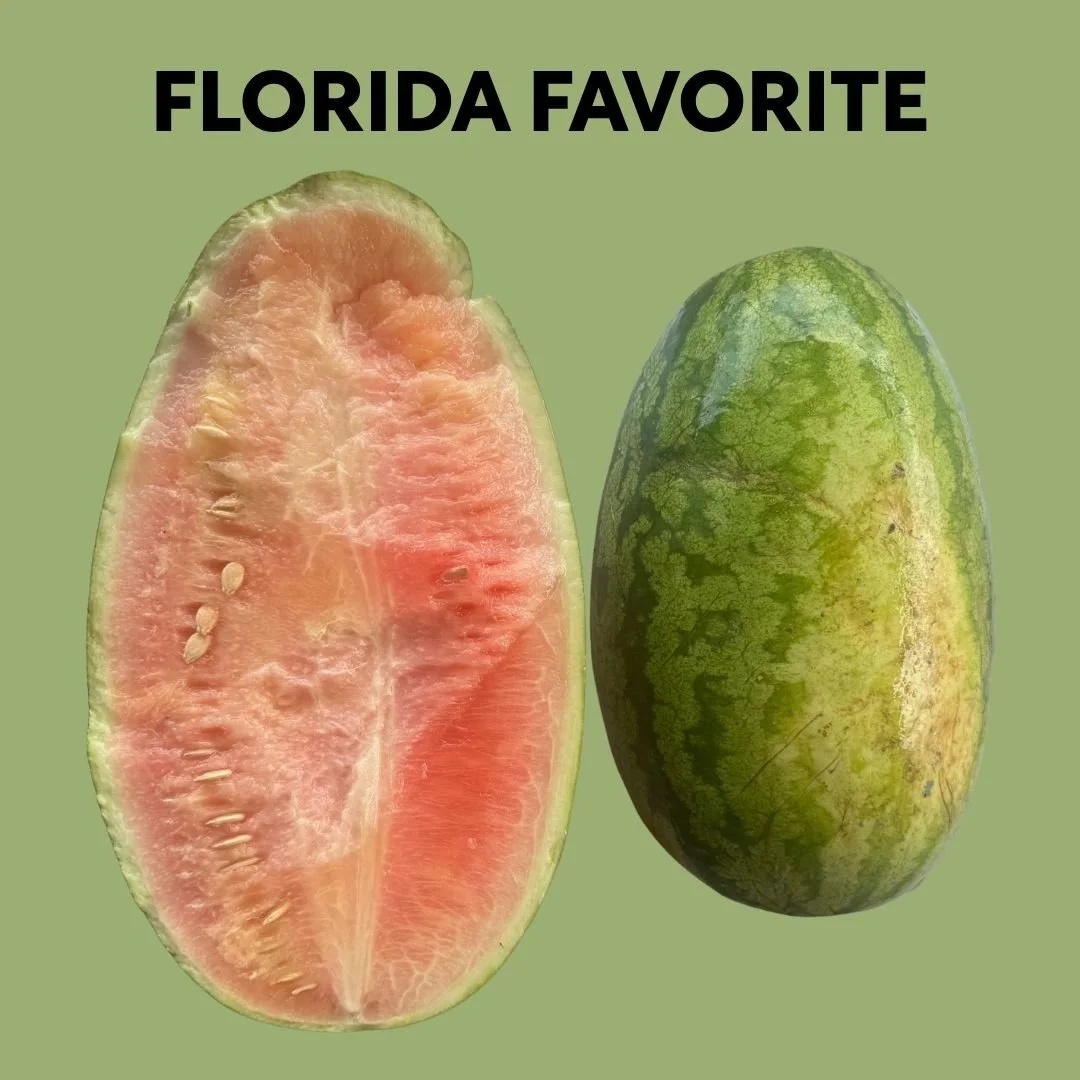
Florida favorite watermelon
Taste profile: Eating quality was the weakest of the varieties evaluated, with tasters describing the fruit as watery, mildly sweet, and distinctly cucumber-like rather than a traditional watermelon profile. Tough seeds, thick rind, and inconsistent ripening further reduced its appeal. Although its appearance was attractive, even fully ripe fruit lacked standout flavor.
Based on these results, we do not plan to continue growing this variety under our conditions. This is Florida’s least favorite!
Moon and Stars
Variety background: A beloved heirloom variety recognized by its dark rind covered with bright yellow spots resembling a starry night sky. This variety has a notable history: it was once considered lost before being rediscovered and reintroduced through the efforts of Seed Savers Exchange. It remains a favorite among gardeners for both its appearance and flavor.
Moon and Stars demonstrated strong field resilience, recovering remarkably well from significant early disease pressure and continuing vigorous growth and fruit production. Fruit shape and size were highly variable, ranging from unusual gourd-like forms to the classic star-speckled oblong melons that define the variety. Four fruit rots were observed, and several mature fruits remained unharvested at the trial’s conclusion.
Median weight: 8.1 lb
Productivity: 0.9 fruit per plant (least productive variety in the trial)
Brix measurement: 7.8°
Disease and pest pressure scale: 7/10
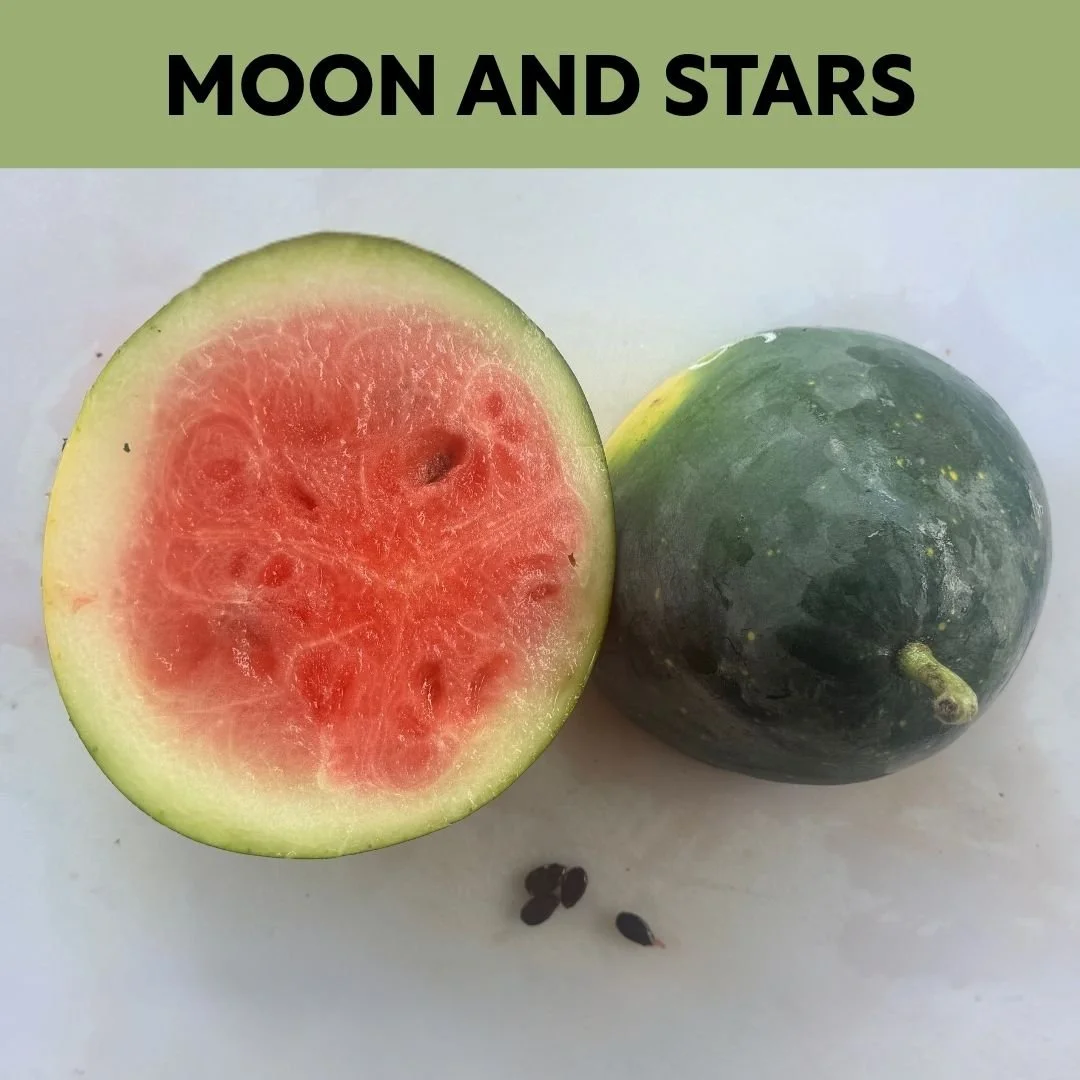
Moon and Stars watermelon
Taste profile: Tasters consistently praised its unique appearance, including the distinctive rind pattern and attractive internal flesh, but eating quality was more modest. Flavor was generally mild with moderate sweetness, and texture ranged from crisp to grainy or slightly rubbery, with large seeds noted as a drawback.
While its beauty and resilience are appealing, its lower productivity and average eating quality make it a lower priority for continued seed stewardship compared to other trial selections.
Yellow
Variety background: This variety came from the collection of seed steward Heron Breen in Maine. According to Heron, the variety was developed and maintained by an elderly farming couple in Wilton, Maine, who simply referred to it as “Yellow Watermelon.” Despite efforts to assign a more distinctive name, the original growers preferred the straightforward description, and we have chosen to honor that tradition. Seed is not commercially available.
Yellow was the strongest performer in terms of productivity and harvest consistency, maintaining good vigor with low pest and disease pressure and producing fruit over an extended harvest window. Its bright striped rind made fruit easy to locate, and maturity indicators were reliable, resulting in few underripe harvests. It had only 2 fruit rots and 1 split, though a notable drawback was its tendency to split under relatively modest pressure.
Median weight: 4.5 lb
Productivity: 2.0 fruit per plant (most productive variety in the trial)
Brix measurement: 9.3° (second-highest Brix measurement)
Disease and pest pressure scale: 2-4/10
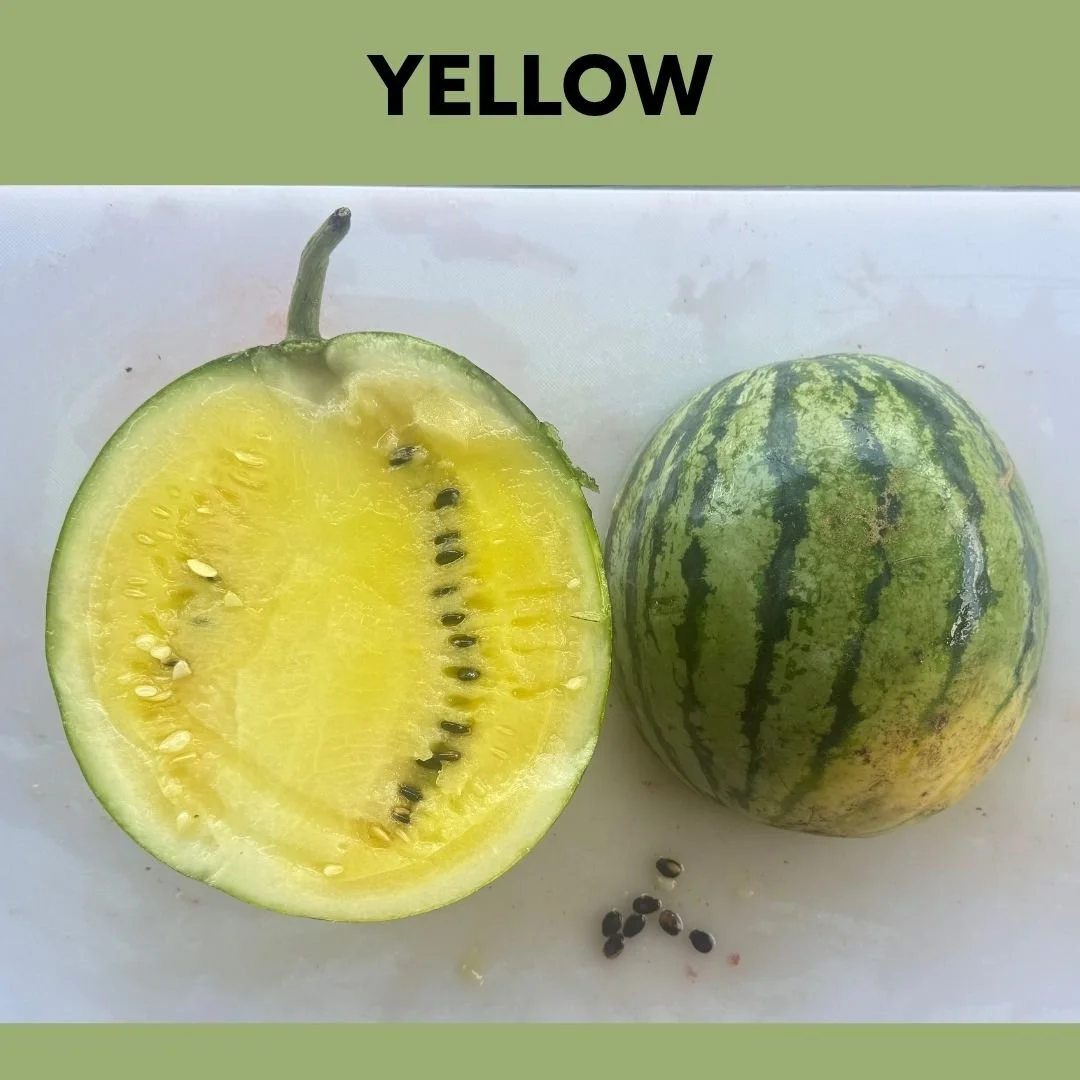
Yellow watermelon
Taste profile: Tasters consistently highlighted its unique flavor profile, including tropical, floral, and candy-like notes while maintaining recognizable watermelon character. Its thin, edible rind, small seeds, striking yellow flesh, and ideal market/CSA size were frequently praised.
Although its softer texture and splitting tendency are considerations, its productivity, flavor, and visual appeal make it a strong candidate for future production.
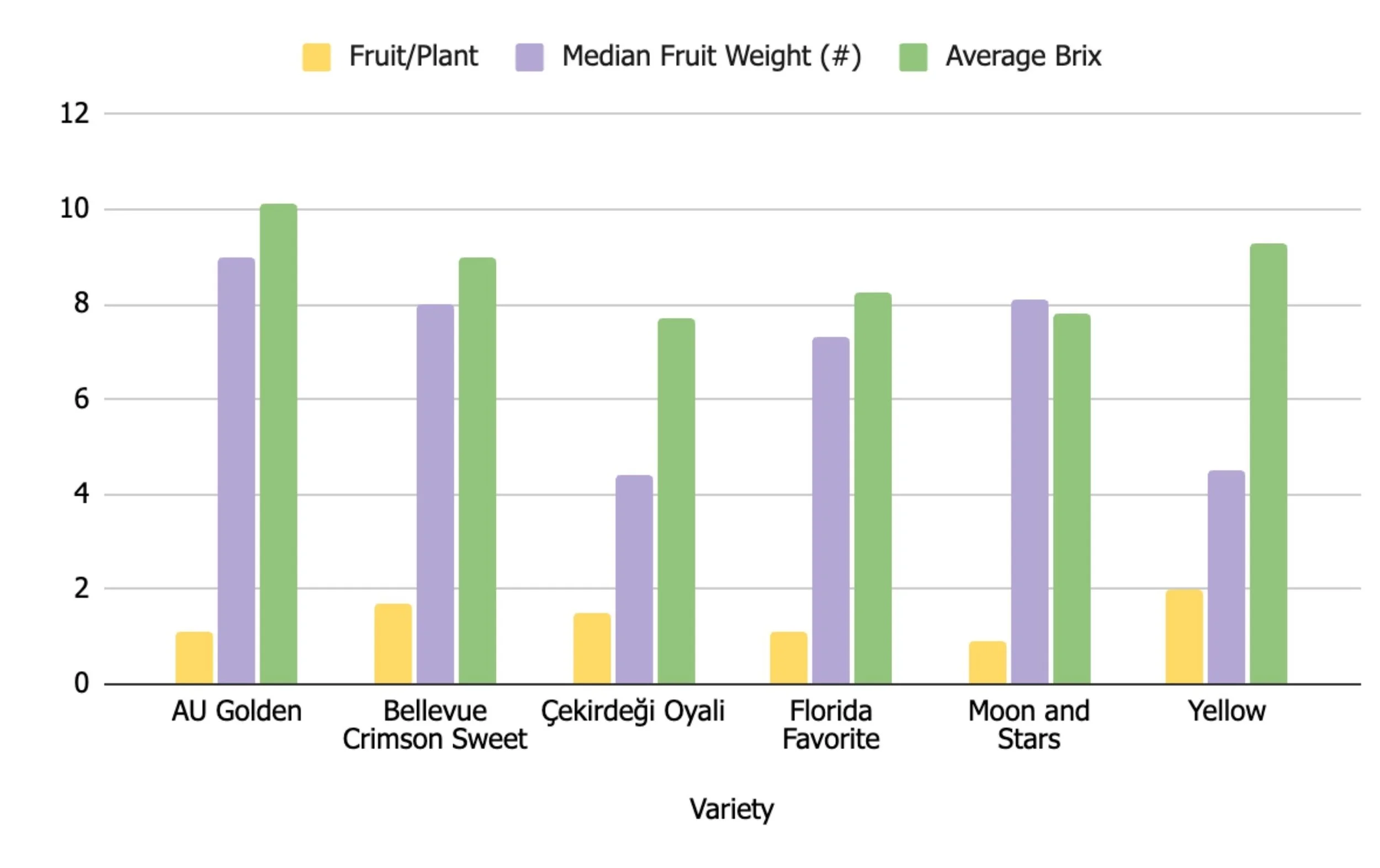
Figure 1: Fruit count/plant (adjusted for differences in number of plants), median fruit weight, and average Brix for each variety.