
By Seed and Garden Director Melissa DeSa
In 2015, we had an ambitious idea to create a new tomato adapted for our area. What would happen if we combined our beloved Everglades tomato with another tomato so very different that we’d get a bigger and more “useful” tomato, but still with big Everglades flavor and tenacity to grow in our climate? You can read more about that journey we called “The Evvy Tomato Project” below.
After nine years of testing and adjusting, we’ve arrived at our unique tomato variety we’ve named “Prairie Cherry.”
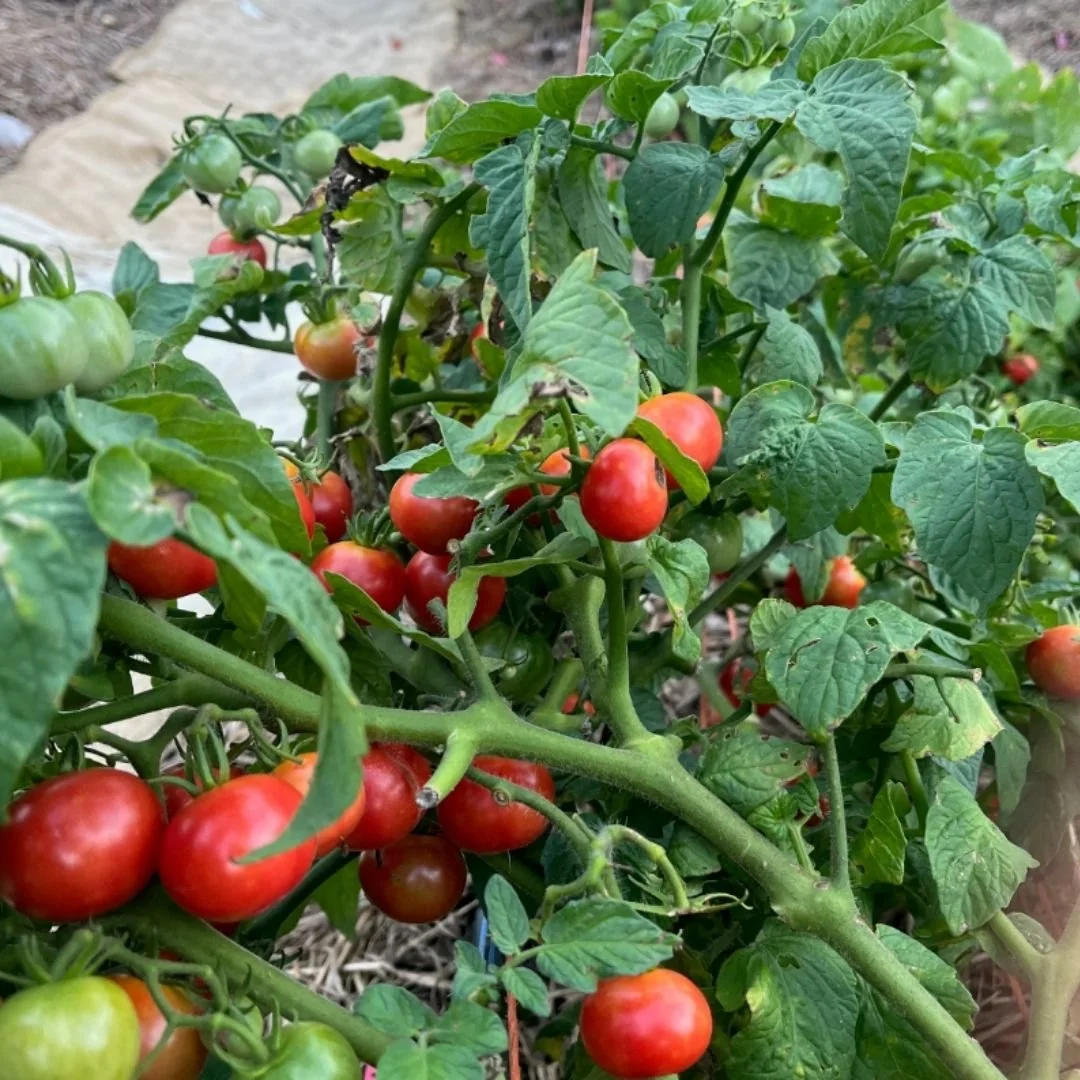
Prairie Cherry tomatoes growing
Each season that we grew out our newly cross-pollinated tomato, we selected for characteristics we wanted from our new tomato:
Larger sized fruit than the tiny Everglades currant
Good flavor
Overall vigor in the field (low pest and disease pressure, healthy looking plants)
General “look and feel” for the plant quality (some were gangly, others too big, some just right)
Truth be told, we learned as we went along. Neither Sarah or I are plant breeding experts. We’ve never even taken a single class on this topic, but had the curiosity and gardening experience to take it on. We phoned friends, read up on literature, and made decisions as we went with the best knowledge we had available to us.
Along the way we engaged growers to give feedback on these plants to make sure we were headed in the right direction, and got plenty of tasting notes to make sure we were creating a tasty new variety. At the end of the day, plant breeding projects like this are as much an art as they are a science. And so we present to the world our collective creative output: the Prairie Cherry Tomato.
This tomato is bred by staff at Working Food in Gainesville, Florida, with lots of community input along the way. A wide cross between the sprawling and wild Everglades currant tomato and a stocky dwarf-sized plant with beefsteak-sized tomatoes, Tanunda Red. Tanunda Red is a product of the collaborative Dwarf Tomato Breeding Project.
The fruits are a medium to large sized pinkish-red cherry and very productive for a small plant. A semi-sprawling dwarf variety with stocky stems and robust, thick, dark green leaves. Plants get no higher than about 2’ and tend to sprawl outwards, so it is best trellised even though small in height. Typical pruning as is done with most tomato varieties is recommended, and maybe even a little bit more to open up some of the dense and compact plants to allow for more airflow.
Fruit tends to be more on the tangy side with flavor descriptions that include: Savory with a hint of umami, a little sweet and tart, juicy, refreshing, and zesty.
While this variety is mostly stable, there is still some variation between plants mostly in terms of slight size/shape differences and fruit sizes. Some fruit will display really nice lobed shoulders and be larger, and occasionally a few fruits are small like Everglades. Some variation in a variety is a good thing, it means there’s more diversity in the genetics and hasn’t entirely been inbred.
Prairie Cherry is open-pollinated, so seeds can be saved and this variety can go on to live and adapt to gardens and farms wherever they may grow: the next chapter of Prairie Cherry!
This was a collective effort and we have heaps of gratitude for the following people and organizations: Craig LeHoullier and Timothy Noyes for being our phone-a-friend tomato breeding consultants. Organic Seed Alliance for the useful online resources on tomato plant breeding. Gainesville Giving Garden [editor’s note: Giving Garden and Working Food merged in 2025] for incredible feedback and garden space to grow enough plants to save seeds in our final year. Organic Crop Improvement Association (OCIA) helped fund this project in 2023, providing critical funding support in our final push to complete this project. Seedlinked supported a national trial for growers outside our community to test out these plants.
Our call out for ideas for naming the variety came up with some good contenders, and we chose Amy Hudson’s suggestion: Prairie Cherry. Last and certainly not least, our Gainesville community at large who helped us make this possible - donors and supporters that help our programs, gardeners that grew these and provided feedback, and taste testers.
Read more about the project’s history below.
A Brief History of The Evvy Tomato Project
How the Seed Was Planted
In 2015 we had an ambitious idea: what would happen if we tried to combine our beloved Everglades currant tomato with a dwarf variety, Tanunda Red? This is a very wide cross of tomato types and traits. Everglades is a different species altogether (Solanum pimpinellifolium) and is the wild ancestor of modern day tomatoes (Solanum lycopersicum), but they can hybridize. If you’ve ever seen an Everglades growing it’s easy to see how they are still wild, sprawling, vigorous, many fruits and many seeds. In fact, they will spread easily although never seem to become invasive. Birds seem to enjoy them, spreading them around the garden and neighborhood. They have great stress tolerance, excellent flavor and grow well in Florida unassisted by the grower. The drawbacks are its sprawling form (although no trellising is required!) and tiny tomatoes that need to be eaten quickly as they do not store well.
Dwarf varieties are relatively new, but becoming more common thanks to efforts of the Dwarf Tomato Breeding Project. Tanunda Red is a determinate variety meaning that the fruits develop within a short window of time. Fruits are quite big ranging from 4-10 oz and of course it’s dwarf in stature. So it’s very different from the indeterminate, sprawling Everglades bearing teeny tiny fruits. Let the fun begin! Welcome to our Evvy Tomato Project!
Goals and Progress
The goal was to create a new variety that is great tasting and able to withstand the extremes of Florida’s growing conditions, but on a more compact dwarf-statured plant with bigger fruit.
Each growing season since that first generation (F1) in 2015 when Craig LeHouillier assisted making the actual hand-pollination cross between the two, we made selections that met our criteria. In 2023, we now hold the F6 seeds (we skipped a couple growing seasons here and there, if you’re doing the math).
We have noticed some degree of resistance to army worms, a major pest of tomatoes, and we’re looking a little more closely at that this season. Last season, our friend Chris Smith of The Utopian Seed Project near Asheville, North Carolina noticed a particularly unusual trait: resistance to herbicides! Some contaminated compost (a growers worst nightmare) impacted other crops including other tomato varieties, but not the Evvies.
One downfall we’ve noticed is the continuation of the less than desirable Everglades trait of fruit splitting, at least some of the plants. Sometimes this is an environmental thing, one of the many we can’t control. But it can also be genetic, so we’ll keep observing.
Community Engagement and Collaborative Breeding
Since our work is all about community, accessibility, and providing plant varieties that are open-pollinated and open-source, we have been using a collaborative plant breeding approach, which is gaining popularity among a subset of the plant breeding/seed saving community. Throughout the project, we invited community members to taste tomatoes which helped us decide which ones to move forward with. The flavor department is just as important as the growing department, but also the most subjective! So more opinions is better data. One person’s worst tomato is another’s favorite. We developed a tomato tasting wheel to help guide tasters’ input. Even during the height of the pandemic, we sent home tasting kits rather than inviting folks indoors to sample.
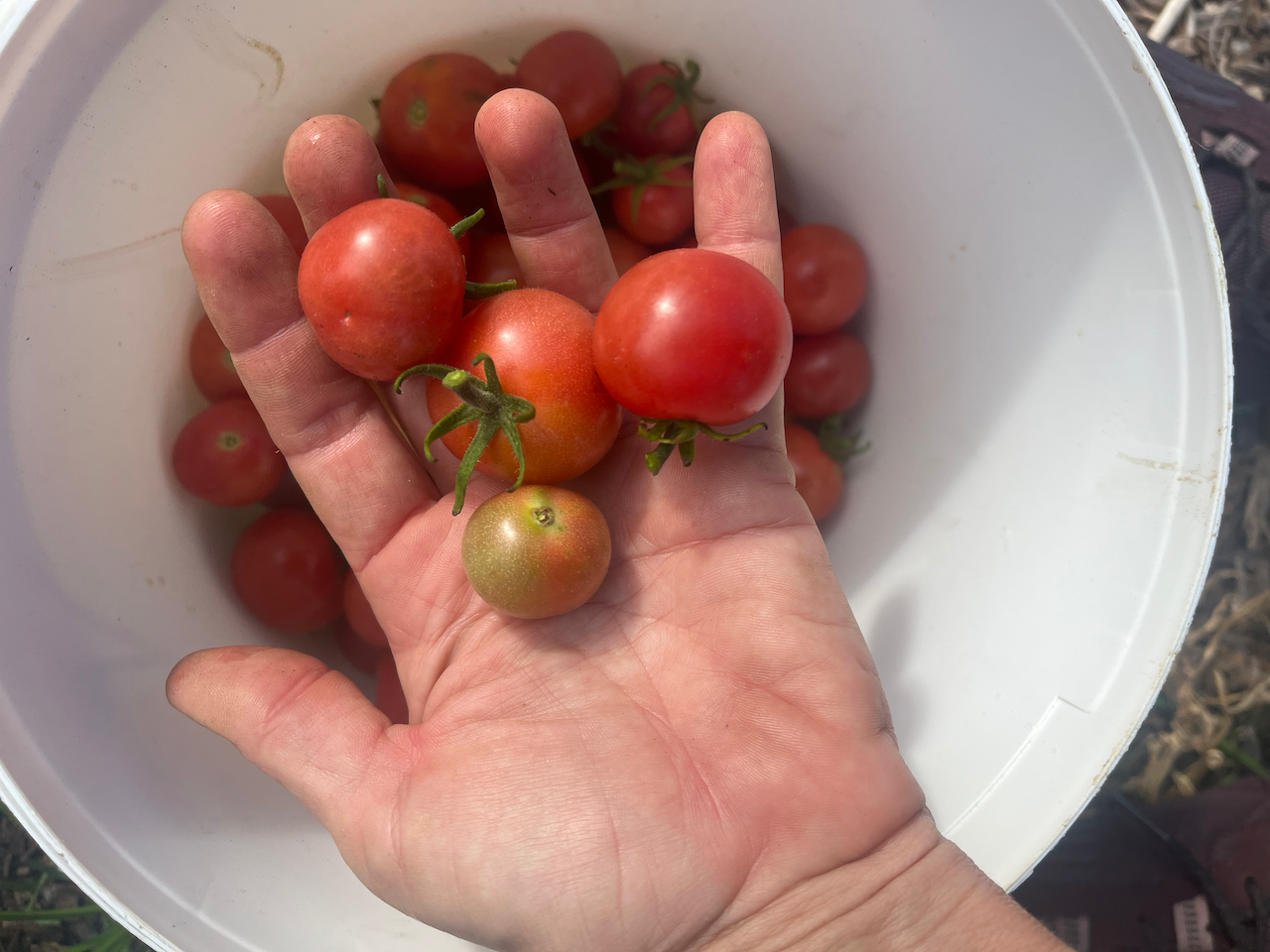
June 1, 2023 - harvested tomatoes from the Evvy tomato project
During the 2022 growing season, 30 individuals grew two of our unique selections that we offered, using the SeedLinked platform to gather the data. The invitation to try growing something really unique and brand new was fun for local gardeners, and a few came back this year to ask about growing them again! The feedback was a mixed bunch, which is expected from an activity that has so much variation in grower experience and acts of god we cannot control when it comes to growing plants! But overall we felt positive that we were on the right path, with a bit more work to do.
What’s Growing On Now?
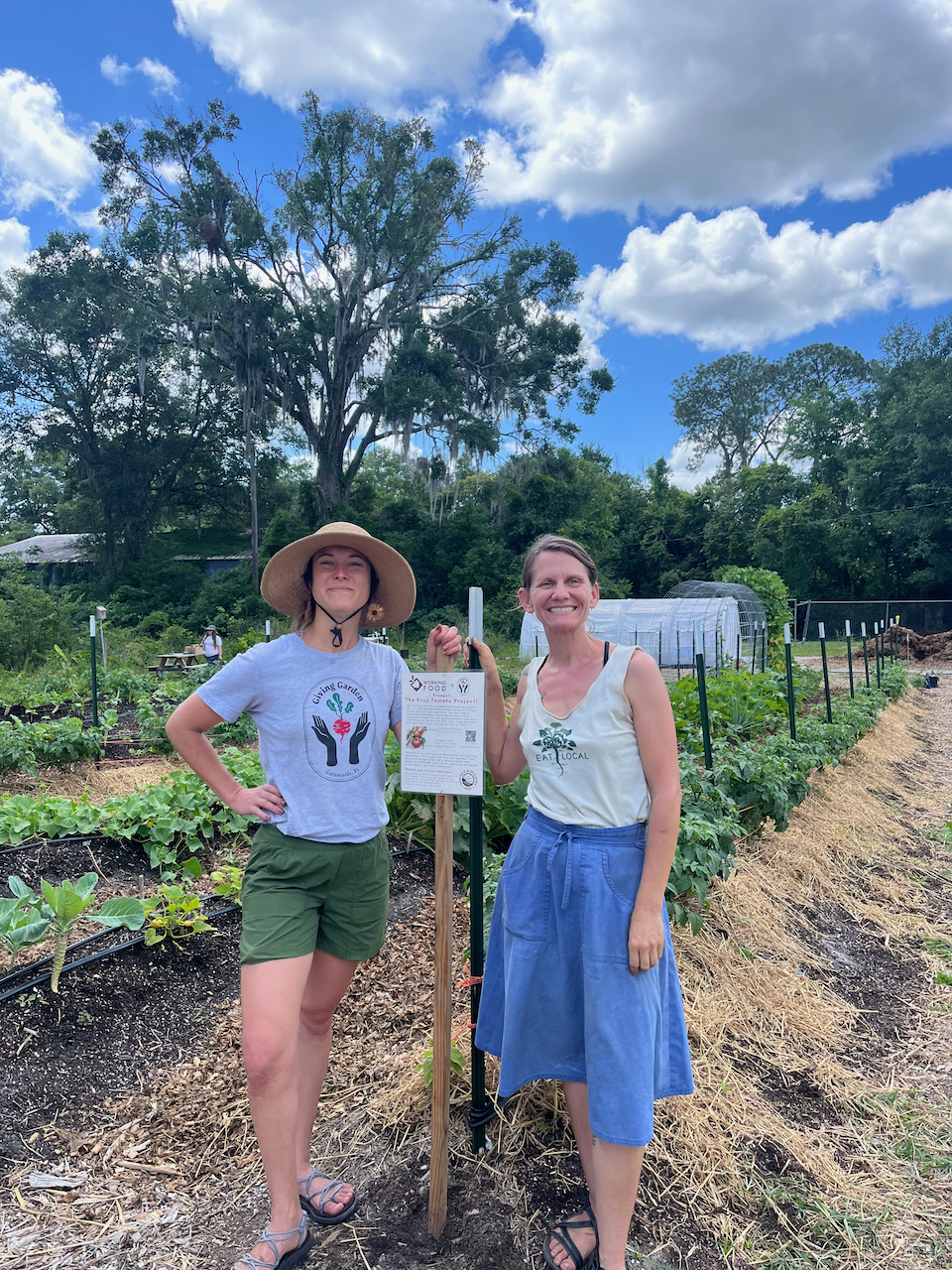
May 7, 2023 - Meg and Mel stand in front of the Giving Garden
As of 2023, we’ve narrowed down two single plant selections from the 2022 season, and are currently growing these out in two locations: Working Food’s seed gardens at GROW HUB and the Gainesville Giving Garden. Instead of the boring names 39H and 39J, which identify the lineage and progress of the project , we’re calling them Happy and Joy. Evvy#39 from last year went out through SeedLinked again, this time as part of a nationwide tomato trial so folks from all over will get a chance to try these in their gardens. It will be interesting to see what growers in different climates have to say about the Evvy tomatoes.
By working collaboratively with a community of growers to provide adapted varieties, we continue growing the locavore movement with a supremely local food product: local food grown from local seed! Ultimately the increase in local growing and eating has beneficial effects for our community, environment, and economy. But it all starts with the seed!
We are grateful for the ongoing expertise and early inspiration of Craig LeHouillier of the Dwarf Tomato Breeding Project and author of Epic Tomatoes, as well as the advice and moral support from local tomato breeder and backyard gardener, Tim Noyes.
In 2023, we were grateful grant recipients from the Organic Crop Improvement Association (OCIA) that is helping fund this season’s breeding efforts, as well as our educational outreach events that have allowed us to host three tomato workshop events and our 3rd annual Seed and Soil School.